

破碎设备Mingyuan Dry and Wet Ball Mill
Customerizable Model for ball mill plant
破碎设备
Mingyuan Dry and Wet Ball Mill
Customerizable Model for ball mill plant
VB 不含增值税
US$560,000
出厂年份
2026
状况
全新
位置
Zheng Zhou Shi 




显示图片
显示地图
机器数据
价格和位置
VB 不含增值税
US$560,000
- 位置:
- Dahuangye Industrial zone, XinXing East RD, Gongyi, 451200 Zhengzhou, China
拨打
优惠详情
- 广告编号:
- A14536393
- 更新:
- 最近更新时间为 08.03.2026
描述
Dry and Wet Ball Mill: Structure, Operation, and Technical Details
A ball mill is a fundamental grinding device used in mineral processing, cement manufacturing, chemical production, and other industrial applications. It works by rotating a cylindrical shell filled with grinding media—usually steel balls—causing impact and friction that reduce materials to fine powder. Based on the grinding environment, ball mills are classified into dry and wet types, each suited for specific materials and process requirements.
Working Principle
Both dry and wet ball mills operate on the same mechanical principle. The rotating cylinder, driven by a motor through a gear system, lifts the grinding media and material along the inner wall. As the rotation continues, the balls fall under gravity, striking and grinding the material. The difference lies in the presence or absence of a liquid medium during grinding.
Dry Ball Mill
A dry ball mill is used when the material must remain moisture-free or when water could affect product quality. It is commonly applied in cement clinker, limestone, quartz, and refractory material grinding. The discharge can be either grate type or overflow type, depending on the desired fineness.
Technical Features:
Feeding size: ≤25 mm
Discharge size: 0.075–0.4 mm
Capacity: 0.65–90 t/h
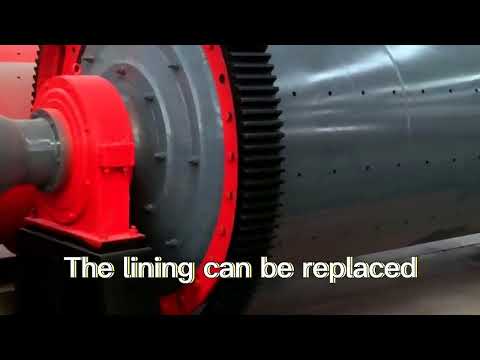
Liner material: High manganese steel or wear-resistant alloy
Drive system: Gear-driven or direct-coupled motor
Dust control: Equipped with air exhaust and dust collector
Advantages:
Suitable for materials sensitive to moisture
No drying process required after grinding
Lower corrosion risk and simpler maintenance
Easier material classification and separation
Limitations:
Dry grinding produces more dust and heat, requiring efficient ventilation and dust collection systems.
Wet Ball Mill
A wet ball mill operates with water or another liquid medium added to the material. The slurry formed during grinding improves efficiency by reducing friction and preventing excessive heat buildup. It is widely used in ore beneficiation, ceramics, and chemical industries.
Technical Features:
Feeding size: ≤25 mm
Discharge size: 0.074–0.2 mm
Capacity: 0.65–615 t/h
Lodpsq Nx Aljfx Af Rjhd
Liner material: Rubber or high-chromium steel
Discharge method: Overflow or grate type
Auxiliary equipment: Classifier, pump, and thickener for slurry circulation
Advantages:
Higher grinding efficiency and finer particle size
Reduced dust and noise levels
Continuous operation suitable for beneficiation circuits
Better control of particle uniformity
Limitations:
Requires drying if the final product must be in powder form and involves more complex slurry handling.
The selection between dry and wet grinding depends on the material characteristics, downstream process, and environmental conditions. Dry mills are preferred for materials that must stay moisture-free, while wet mills are ideal for fine grinding and slurry-based processes.
Conclusion
Dry and wet ball mills share the same mechanical structure but differ in their grinding environment and application scope. The dry type offers simplicity and low maintenance for moisture-sensitive materials, while the wet type provides higher efficiency and finer output for mineral and chemical processing. Understanding their technical parameters and operational differences ensures optimal equipment selection, improved productivity, and reliable performance in industrial grinding operations.
A ball mill is a fundamental grinding device used in mineral processing, cement manufacturing, chemical production, and other industrial applications. It works by rotating a cylindrical shell filled with grinding media—usually steel balls—causing impact and friction that reduce materials to fine powder. Based on the grinding environment, ball mills are classified into dry and wet types, each suited for specific materials and process requirements.
Working Principle
Both dry and wet ball mills operate on the same mechanical principle. The rotating cylinder, driven by a motor through a gear system, lifts the grinding media and material along the inner wall. As the rotation continues, the balls fall under gravity, striking and grinding the material. The difference lies in the presence or absence of a liquid medium during grinding.
Dry Ball Mill
A dry ball mill is used when the material must remain moisture-free or when water could affect product quality. It is commonly applied in cement clinker, limestone, quartz, and refractory material grinding. The discharge can be either grate type or overflow type, depending on the desired fineness.
Technical Features:
Feeding size: ≤25 mm
Discharge size: 0.075–0.4 mm
Capacity: 0.65–90 t/h
Liner material: High manganese steel or wear-resistant alloy
Drive system: Gear-driven or direct-coupled motor
Dust control: Equipped with air exhaust and dust collector
Advantages:
Suitable for materials sensitive to moisture
No drying process required after grinding
Lower corrosion risk and simpler maintenance
Easier material classification and separation
Limitations:
Dry grinding produces more dust and heat, requiring efficient ventilation and dust collection systems.
Wet Ball Mill
A wet ball mill operates with water or another liquid medium added to the material. The slurry formed during grinding improves efficiency by reducing friction and preventing excessive heat buildup. It is widely used in ore beneficiation, ceramics, and chemical industries.
Technical Features:
Feeding size: ≤25 mm
Discharge size: 0.074–0.2 mm
Capacity: 0.65–615 t/h
Lodpsq Nx Aljfx Af Rjhd
Liner material: Rubber or high-chromium steel
Discharge method: Overflow or grate type
Auxiliary equipment: Classifier, pump, and thickener for slurry circulation
Advantages:
Higher grinding efficiency and finer particle size
Reduced dust and noise levels
Continuous operation suitable for beneficiation circuits
Better control of particle uniformity
Limitations:
Requires drying if the final product must be in powder form and involves more complex slurry handling.
The selection between dry and wet grinding depends on the material characteristics, downstream process, and environmental conditions. Dry mills are preferred for materials that must stay moisture-free, while wet mills are ideal for fine grinding and slurry-based processes.
Conclusion
Dry and wet ball mills share the same mechanical structure but differ in their grinding environment and application scope. The dry type offers simplicity and low maintenance for moisture-sensitive materials, while the wet type provides higher efficiency and finer output for mineral and chemical processing. Understanding their technical parameters and operational differences ensures optimal equipment selection, improved productivity, and reliable performance in industrial grinding operations.
供應商
注意: 免费注册或登录,以获取所有信息。
注册于: 2024
50 在线广告

发送询价
电话 & 传真
+86 150 9... 广告
这些广告您可能也感兴趣。
小广告

 Dinkelscherben
7,368 km
提升磁铁磁选机
die magnetprofisPEM202200
die magnetprofisPEM202200
小广告


 Dudullu OSB
6,362 km
分切生产线
BOSPORASNarrow Width Coil Slitting Line
BOSPORASNarrow Width Coil Slitting Line
小广告
 Hohenems
7,477 km
螺杆压缩机
Atlas Copco, Kaeser, Boge, CompAirGA15-75, BSD72-CSDX162, SLF75, L75
Atlas Copco, Kaeser, Boge, CompAirGA15-75, BSD72-CSDX162, SLF75, L75

小广告
 Schorfheide
6,952 km
筛网/破碎机
Sonstige/OtherGasparin Backenbrechanlage GI107CV VESUVIO
Sonstige/OtherGasparin Backenbrechanlage GI107CV VESUVIO
小广告


 Dordrecht
7,548 km
总计
Caterpillar3516B HD - 2.500 kVA Generator - DPX-18107
Caterpillar3516B HD - 2.500 kVA Generator - DPX-18107
小广告


 Peterslahr
7,445 km
建筑起重机
Sonstige/OtherLink-Belt RTC-80100 II
Sonstige/OtherLink-Belt RTC-80100 II
小广告


 Fuldatal
7,277 km
永久-磁性卡盘
小广告


 Zheng Zhou Shi
809 km
磨粉机
Fine powder grinding mill, clinker millSuperfine ball mill for micro powder
Fine powder grinding mill, clinker millSuperfine ball mill for micro powder
小广告
 Fevziçakmak
6,217 km
板材矫直机/整平机
TFON MACHINE CO.Leveling Machine - TF-S 3513
TFON MACHINE CO.Leveling Machine - TF-S 3513
小广告


 Ursberg
7,381 km
卸料带 角度输送机 磁铁
die magnetprofis2023011201
die magnetprofis2023011201
您的广告已成功删除
发生错误

Machineseeker-信任认证标志
什么是可信印章?
Machineseeker通过Machineseeker信任标志认证精选经销商。 在发放之前,Machineseeker 经验丰富的员工会进行标准化和全面的检测。
我们检查什么?

检查
营业执照或商业登记摘录
检查经销商的
邮寄地址
银行账户信息验证
主电话号码的
电话
可接通性验证
企业信用报告
不得显示任何负面特征
买家的投诉
可能导致认证标志被撤销这对您作为买家意味着什么?
通过 Machineseeker 信任标识,您作为买家无需自行检查,就可以识别出极有可能进行诚信且合法经营的可信经销商。
当然,在购买过程中仍可能出现分歧。 Machineseeker 对在 Machineseeker 上活跃的买家或卖家的法律违规行为不承担责任。